Templars Academy 'Reach, Believe, Achieve'
Attendance
Attendance and punctuality matters. Every day counts!
The Importance of Good Attendance
At Templars Academy, we promote the view that regular attendance is of the highest importance, in ensuring the best possible learning outcomes for all of our children.
Statistics show a direct link between under-achievement and poor attendance.
Children with good attendance:
- make better progress, both socially and academically
- find school routines and school work better to cope with
- have an easier transition between key points in their education
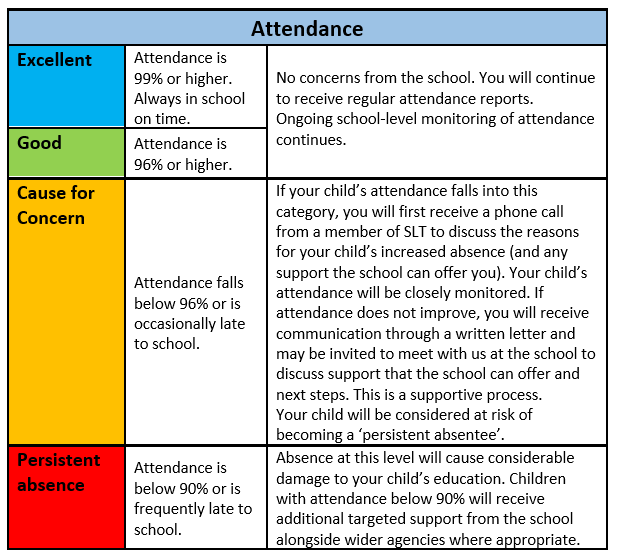
At Templars Academy, we believe in developing good patterns of attendance and set high expectations for the attendance and punctuality for all our pupils from the outset. It is a central part of our school’s vision, values, ethos, and day-to-day life. We recognise the connections between attendance, attainment, safeguarding and wellbeing.
Understanding types of absence
Any absence affects the pattern of a child’s schooling and regular absence will seriously affect their learning. Any pupil’s absence or late arrival disrupts teaching routines and so may affect the learning of others in the same class. Ensuring a child’s regular attendance at school is a parental responsibility and allowing absence from school without a good reason creates an offence in law and may result in prosecution.
Every half-day absence from school has to be classified by the school (not by the parent), as either authorised or unauthorised. This is why information about the cause of any absence is always required. Each half-day is known as a ‘session’.
Authorised absences are morning or afternoon sessions away from school for a genuine reason such as illness (although you may be asked to provide medical evidence for your child before this can be authorised), medical or dental appointments which unavoidably fall in school time, emergencies or other unavoidable cause.
Unauthorised absences are those which the school does not consider reasonable and for which no ‘leave’ has been granted. This type of absence can lead to the school referring to the Local Authority for penalty notices and/or legal proceedings.
Types of Absence (lists are not exhaustive):
| Authorised | Unauthorised |
|
-Genuine illness -Medical appointments which cannot be made outside of school hours -A day set aside for religious observance -Approved sporting events -Absence due to exceptional circumstances (see attendance policy) |
-Unauthorised holidays -Children who arrive too late to be registered -Going for a family day out -Sibling or parent illness -A child or family members birthday -Going shopping -Overslept or had a late night the night before -Visiting friends or relatives -Tiredness/ needing a ‘rest day’ |
Please see the Attendance Policy for full details of which circumstances will not be authorised.
Holidays in Term Time
There is no entitlement in law for pupils to take time off during the term to go on holiday.
The law specifies that headteachers may not grant any leave of absence during term time unless there are "exceptional circumstances". The School Attendance (Pupil Registration) (England) Regulations 2024 state that “the need or desire for a holiday” is not considered an exceptional circumstance.
At Templars Academy 'exceptional circumstances' will be interpreted as:
... being of unique and significant emotional, educational or spiritual value to the child which outweighs the loss of teaching time and cannot be taken outside of term time.
It is important for parents/carers to be aware that while decisions will be made on a case-by-case basis, requests will normally be refused.
The Department for Education has introduced a new statutory National Framework, that all schools in England must follow.
- There is now a single consistent national threshold for when a penalty notice must be considered by all schools in England of 10 sessions (usually equivalent to 5 school days) of unauthorised absence within a rolling 10 school week period. These sessions do not have to be consecutive and can be made up of a combination of any type of unauthorised absence, including lateness.
- If a Penalty Notice is issued for an offence of unauthorised absence, the first offence will attract a fine of up to £160 per parent per child (£80 if paid within 21 days);
- A second offence in three years will attract a fine of £160 per parent per child.
- Schools cannot issue a third penalty notice in 3 years, and must consider other sanctions, which may include prosecution.
Please speak to the school if you need more information about the new rules.
Attendance Procedures
If you know your child is going to be absent from school, you are asked to contact the school office by telephone or in person by 9:00am, giving the reason for the absence. We ask that you phone school on EACH DAY of your child’s absence, not just the first day. If no call is received, school will make contact with you to establish the reason for their absence. This will allow us to mark your child’s absence on the register as ‘authorised’ or ‘unauthorised’. If no contact can be made, our ‘Missing children from education’ process begins in line with our safeguarding policy. Home visits will be carried out in some circumstances if we cannot get hold of you.